As part of our blog series about women medical pioneers, it was my great pleasure and privilege to meet the remarkable Dr Jean Walinck, who became the first-ever female partner in North Berwick Medical Practice, 60 years before I began my own GP training there.
Read on to find out about her experience of being a female medical student in the 1950s, her thoughts on the gender pay gap, her worst and most exciting days in General Practice, and of course, her opinions on doctors’ bags.
A Turbulent Start
At 92 years of age, Dr Walinck remains incredibly bright, determined, and full of enthusiasm. She is highly animated and engaging when describing her fascinating experiences of life and work.
Born in 1930, Dr Jean Walinck is the only child of 2 maths teachers. She maintains that her existence is a miracle, and that her parents’ struggles contributed to her strength of character and identity as a “survivor.”
Her father served in the RAF in the First World War. Whilst taking pictures of enemy territory he was shot down in Turkey. “If he hadn’t been rescued, I wouldn’t have been here,” muses Jean.
Her mother was 31 years of age and had no idea she was 3 months pregnant when she succumbed to acute appendicitis. Baby Jean survived the anaesthetic for the emergency operation at 12 weeks’ gestation and was born, perfectly healthy, 6 months later.
Trailblazing For Women in Medicine
Jean began her studies at Edinburgh Medical School in 1948 as one of 34 females in a class of 150. Although she felt no barriers to entering university, once there she recalls, “I always felt I had to work twice as hard (as the men) to be appreciated.”
One retired professor of Anatomy didn’t approve of women in medicine at all and wouldn’t go near any of the girls in the class. “He only spoke to the men at their anatomy tables.”
After graduating in 1954, Dr Walinck’s first job as a junior doctor was on a surgical ward at Edinburgh Western General Hospital. Unfortunately, the Accident and Emergency post was unfilled due to a lack of applicants that year. This meant that Dr Walinck and one of her colleagues had to cover A&E in addition to their surgical wards, taking turns to work alternate nights.
In return for their services, they were paid £450 per year with £125 deducted by the hospital as reimbursement for their board and lodgings. Dr Walinck lost half a stone in the first 6 weeks, not only because of the gruelling hours, but also because of ongoing food rationing following World War II.
Dr Walinck completed her hospital training at The Simpsons Maternity Hospital, The Royal Hospital for Sick Children in Edinburgh and Bangour. She then spent a year as a GP Trainee at a single-handed General Practice in St John’s Road, Edinburgh, run by Dr Betty Hamilton.
“Dr Hamilton did most of the work and thought I was much too young. But she would leave me on my own to run the practice when she went on holiday,” recalls Dr Walinck.
As a fully qualified GP, Dr Walinck applied for a 6-month locum job in North Berwick. After 3 months she was offered partnership. She accepted, despite being paid a fraction of the salary of the male GP partners.
“I loved the town and the views of the sea.” Dr Walinck cared for the community of North Berwick and the surrounding area from 1958 until 1990. Her previous experience in A&E enabled her to run a minor injuries facility in the small community hospital adjoining the practice.
Barriers for Female Doctors
Being new, young, and female, she had to overcome a number of barriers in order to prove her abilities and justify her position to her patients.
Dr Walinck vividly recollects visiting an old lady in the country and overhearing a conversation between the patient and her friend as she walked up the path to her door. “Is that the doctor coming now?” asked the old lady, “Oh no no no,” said her friend dismissively, “that’s just a wee lassie with a bag.”
On another occasion, she was on call from home at the weekend. An elderly man phoned to request a visit and assumed that the female voice on the other end of the line belonged to one of the doctors’ wives, or a receptionist.
After demanding an urgent visit, he added, “And don’t send that new Dr Walinck!” She took a deep breath in, drew herself up to her full height and retorted,” This is Dr Walinck and I’m the only doctor on call, so do you want a visit or not?” “Erm, yes,” he replied, “I suppose you’d better come.”
Dr Walinck’s worst day in General Practice came during the flu pandemic of 1970. Several her colleagues were ill and one of the partners had recently dropped dead whilst on holiday. Staff shortages meant that Dr Walinck was one of only 2 doctors that day required to fulfil a total of 60 requests for house calls! Apparently, she had lost her patience by number 28!
Different Times
I shudder at the thought as she tells me how she used to drive 1000 miles per month around an area which extended from Longniddry to the boys’ boarding school in Dunbar.
“The most exciting day of my life,” smiles Dr Walinck, “was in 1973, when I was winched up in a helicopter and taken to rescue a teenage boy who had slipped over the side of Tantallon Cliffs. I had never been in a helicopter before!”
It is hard for me, as a modern-day GP, to imagine how I would feel about being asked to take part in such a dramatic scenario. However, Dr Walinck accepted the challenge with relish. The helicopter did not land; instead, a rope was lowered, and Dr Walinck was instructed on how to get into the harness.
Having managed this with some difficulty, and a little bit of damage to her own knees, she was hoisted up to board the flight. On arrival at the scene, Dr Walinck was lowered down to the patient who was lying on rocks at the base of the cliff. The boy had fallen 120 feet but was still conscious, and Dr Walinck was able to administer morphine for his pain before he was airlifted to hospital.
On her return to the practice, her male GP colleagues seemed to be relieved that it had been her and not them. However, making light of her heroic venture, one remarked “I hope you were wearing your trousers!”
Amongst a collection of wonderful stories, which would make a marvellous book, Dr Walinck also described to me how she delivered a 13 lb baby at home, pacified a young man who had “gone daft” at 3am one morning, bandaged victims of a serious car crash, and narrowly avoided twins being born in her waiting room.
A Busy Retirement
After retiring from General Practice, Dr Walinck worked as a Medical Referee for East Lothian Council as well as the Department of Health and Social Services. She assessed patients’ eligibility to receive disability living allowances for 10 years before retiring in 2000.
Dr Walinck particularly recalls 3 men affected by Gulf War Syndrome. “They had lost their marriages, homes, kids. Their lungs weren’t right… real invalids. One was a PE instructor who had been terribly fit.”
Dr Walinck never married. “I knew other lady doctors in the area and none of them were married. I don’t think it would have been possible to do the job we were doing full time and to look after a husband and family.”
However, in 2004 she met a widower, Mr G Wallace Lockhart who ran a music group. During their eight and a half years together, they travelled to 13 countries, giving concerts to raise money for humanitarian projects.
Dr Walinck was the group’s attending physician. Their first trip was to Nanyuki, a town 40 miles from Nairobi in Kenya, where the people relied on agriculture for subsistence.
To work in the food processing factories, however, it was compulsory to have vaccinations, so people had to walk 40 miles to Nairobi to get them. The orchestra gave 9 concerts over 3 weeks, raising £7000 to build a medical clinic in Nanyuki.
Dr Walinck now continues in her charitable work from home by making beautiful quilts for Project Linus UK. This organisation’s aim is ‘to provide love, a sense of security, warmth and comfort to children, who are sick, disabled, disadvantaged or distressed by donating gifts of NEW, HOMEMADE, WASHABLE quilts and blankets, lovingly made by UK volunteer knitters and quilters.’
Doctors’ Bags: Then and Now
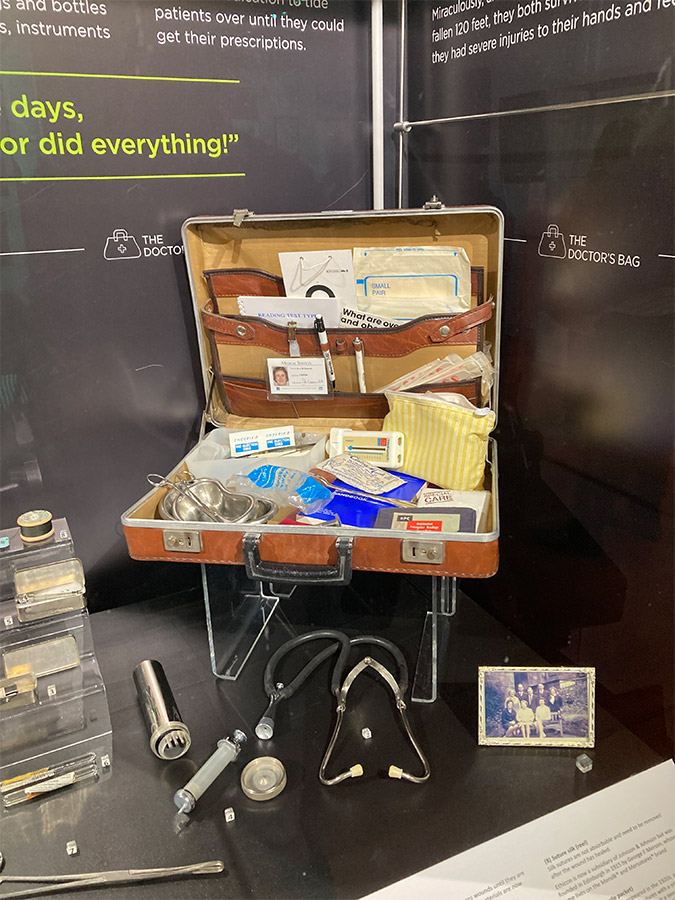
Finally, we discussed Doctors’ Bags! Dr Walinck’s bag, (along with her medical instruments and text books), is now proudly displayed in the North Berwick Museum. It undoubtedly holds many of her wonderful memories.
Dr Walinck was delighted to see my collection of modern-day bags designed for women in Medicine and to hear about IYASU. “I think they’re wonderful,” she said, choosing the Elizabeth in Red as her favourite!
Well, Dr Walinck, we think you’re pretty wonderful too!