

GP and Author
Meet Dr Amanda Brown, a GP and prison doctor, as part of our series “Inspirational You, Awesome Sisters United”.
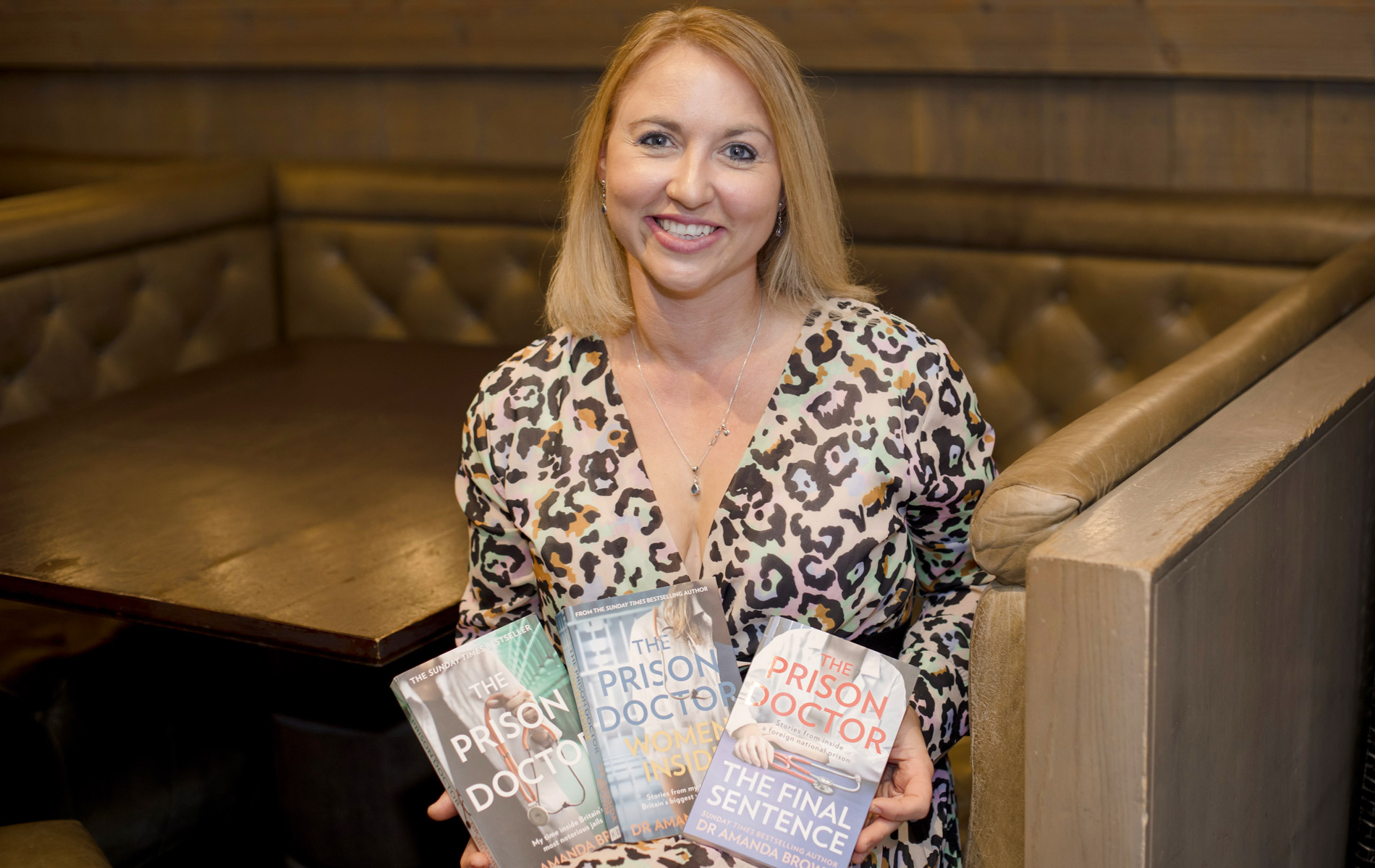
Dr Amanda Brown is a GP, Mother of two, and author of bestselling memoirs:
Out beyond ideas of wrongdoing and rightdoing, there is a field. I’ll meet you there – Rumi
This is one of Dr Amanda Brown’s favourite quotes. It epitomises the grey areas of life where neither right nor wrong are fully true, a world in which flawed people can be understood and treated as humans who need care, regardless of their deeds.
Pursuing a Dream
Amanda was born in 1954 in the East End of London. She and her elder sister grew up in a house that was part family home, part doctor’s surgery. Amanda’s father was a GP, and his practice was located in the downstairs area of their semi-detached residence.
From the beginning, medicine was a part of Amanda’s daily life. She watched the patients come and go, caught glimpses of her father consulting with them, and became fascinated by his work. Sometimes, at weekends, she would be allowed to accompany her father in his little Morris Minor to go on home visits. She would wait in the car while he examined the patients, then quiz him on his return.
At Christmas, Amanda’s family would make up food hampers with fresh chicken and other treats to give to elderly and lonely patients who had little. Amanda saw the joy that her father brought to these people and appreciated how his kindness and generosity made a positive difference.
By the age of 7, Amanda knew she wanted to be a doctor and could not imagine a career in any other profession. However, growing up as she did in the 50’s and 60’s, career choices for women were very limited. There was a strong expectation that Amanda would become either a nurse, a secretary, or a teacher.
When Amanda told her teachers that she aspired to be a doctor, they cautioned her that it would be too difficult to get into medical school and it was a career much more suited to men.
“I had to work extremely hard and never really believed in myself, but I just wanted it so, so badly. I couldn’t imagine any other way to live my life.”
Although she often doubted herself, Amanda could not and would not be dissuaded from pursuing her dream. She studied ceaselessly, hiding away in an eaves cupboard just big enough to fit a small desk, lamp, and chair.
She managed to get a summer job in a hospital working as a cleaner so that she could gain an insight into life on the wards. Eventually, her hard work was rewarded with the arrival of her A-level results. Amanda had achieved the required grades to enrol at Medical School.
Bullies and Supporters
Dr Amanda Brown started training at the London Hospital in 1973. Her class was 25% female, 75% male. Amanda and her fellow medical students were required to study Anatomy, Biochemistry and Physiology for 2 years before being allowed to examine real patients on the wards.
Her conscientious nature ensured that Amanda progressed smoothly through medical school, meeting all examination requirements, and additionally completing an intercalated BSc degree.
However, during her 4th year she encountered a barrier to her so far unhindered progress. Professor Anderson, a formidable surgeon, retained the antiquated opinion that women had no place in medicine. He habitually humiliated female medical students at any opportunity afforded him.
During a tutorial on lumps in the groin, Amanda became his latest victim. He grilled her mercilessly, far beyond the expected knowledge for her stage. Mortified, Amanda was left standing, speechless in front of her group. The next day she started to experience anxiety and panic attacks.
Her self-doubt spiralled and suffocated her. Each time she got off the tube at Whitechapel and saw the hospital, her heart would start to race, her hands become clammy, and her mouth painfully dry. She hyperventilated until she felt dizzy, and she felt lonely, dejected, and stupid.
To her horror, one month after the most torturous of tutorials, Amanda was summoned to see the Dean of the medical school. She entered his imposing office with trepidation, convinced that she would be asked to leave. The Dean informed her that Professor Anderson had indeed conveyed his opinion that she was not fit to sit her final exams.
However, the Dean continued to tell Amanda that he was convinced that she was going to pass and make a great success of her career in medicine. He then offered Amanda a job working with his firm as a houseman following her graduation.
Dr Amanda Brown has never forgotten how this wonderful man’s belief saved her after a bully almost destroyed her career. Ever since this experience, she has tried to champion people that others have treated badly and unfairly, acutely aware of the difference kindness can make to anyone, especially at their most vulnerable.
Patient-centred and Holistic
On completion of her training, Amanda became a GP in a village in Buckinghamshire. She established her own practice and built up her list in a friendly community where she helped people of all ages from widely differing backgrounds. She loved her job and always felt privileged to be involved with the lives of so many interesting people.
In 2004, two decades after Dr Amanda Brown began her practice, unprecedented changes to primary care changed the working style of GPs dramatically. The government introduced QOF, a system whereby doctors had to record innumerable statistics about patients in order to be paid.
Amanda felt this would irreparably change the nature of her work and negatively impact on the quality of her consultations with patients. She was not a doctor who wanted to be driven by the recording of numbers to reach financial targets, but rather remembered for her patient-centred, holistic care.
At the age of 49, she impulsively resigned during a heated argument about the changes. That night she penned a furious article to PULSE, a widely read medical magazine, and was published on its front page.
Amanda was shocked at herself and felt a tremendous loss. She had no job and no Plan B. Her patients were also devastated and begged her to return.
However, whilst Amanda felt lost, many recognised that the passionate, caring doctor behind the words of the publication had much to offer in other health services. A serendipitous phone call from a recruiter for prison doctors led Dr Amanda Brown to her new calling.
Compassion without Judgement
Life as a prison doctor was quite a contrast to life as a suburban GP.
There were several new rules for Amanda to learn: no short skirts (too provocative), no jewellery, no phone, no chewing gum (this could be used by prisoners to make impressions of keys). Sit nearest the door in the consultation. Know where the panic button is. Never share any personal details about yourself or your family. Key training is essential, and every gate must be locked and double checked.
Huntercombe
Dr Amanda Brown’s first post was in Huntercombe, an institution for young offenders aged 15-18. Medical challenges were minimal but extra vigilance was required to avoid being outwitted.
To her consternation, Amanda’s first surgery consisted of a string of boys complaining of aching feet. It took a few patients before she realised that they were trying to obtain a medical note from her to allow them to wear their own trainers instead of the ugly, standard-issue prison shoes.
On another occasion a small group of boys conspired to present with genital problems, one after the other, just to try to shock and intimidate her.
Aside from these occasional irritations, Amanda felt great sympathy with the boys. Unlike her own sons, who were the same age, many of the teenagers in Huntercombe had grown up in care with a complete lack of loving support. The stories of their lives saddened her, but Amanda saw potential in many and tried to help them to see a meaningful life beyond bars.
She began to feel detached from her own privileged middle-class community and less able to engage in conversations about material things or trivial first-world problems. She saw the boys in Huntercombe struggling with exceptionally real life-changing problems that the society in Amanda’s world outside prison could barely imagine.
Wormwood Scrubs
After 5 years working with teenagers, Amanda felt ready to take on a greater challenge. Others may have retired at this point with a self-satisfied feeling of having “done their bit for society”. Instead, Amanda applied to work as a doctor in one of the oldest and most notorious prisons in the UK: Wormwood Scrubs.
Amanda’s book, The Prison Doctor, is a Sunday Times Bestseller in which she details her experiences inside this vast, imposing Victorian institution. As duty doctor in “The Scrubs”, she faced a much more serious array of medical problems. Amanda recalls horrific attacks by prisoners on each other including violent beatings and the use of boiling sugar water to inflict excruciating burns.
Self-harm was common but none more dramatic than the attempted suicide by a young man who slit his own throat. Amanda describes pressing desperately on his neck whilst kneeling in a deepening pool of blood as he slipped into unconsciousness. Incredulously, this man survived and returned from hospital to thank her for saving his life.
Some men were angry and rude, but amidst the harsh, rawness of prison life others retained their sense of humour and made her laugh. A jewellery robber presented her with a catalogue, promising he could get her anything she cared to choose. Another called her “an angel in a shit hole,” and several made her gifts. Amanda describes how touched she was to receive a beautifully carved model of a car that one of the prisoners in the segregation wing had fashioned from a piece of soap.
For the most part, Amanda had little or no knowledge of their crimes and was able to offer the men help and compassion without judgement. However, during her time at The Scrubs, an epidemic which had no cure spread throughout the prison. Amanda was faced with increasing numbers of men using Spice, a psychoactive drug which caused wild and frightening behaviour. Sadly, the increasing prevalence of misuse of this substance meant it was too dangerous for her to continue to work there.
Being an Unexpected Ally
Bronzefield Women’s Prison
Having been advised throughout her career as a prison doctor to avoid working with women, Amanda was somewhat apprehensive about her next post in Bronzefield, Europe’s largest female prison. Cautiously, she opted for a few locum shifts so that she could experience the job without a binding commitment.
To her amazement, Dr Amanda Brown loved the work and soon took up a regular position at this category A prison, home to the women deemed to pose the highest threat to public, police, or national security.
Although the women in Bronzefield initially appeared diverse in age, ethnicities, and backgrounds, Amanda soon discovered that most shared a heart-breaking common denominator. Over 85% of the female prisoners had themselves been victims of physical or sexual abuse in childhood or adult life.
Some had turned to drugs for escapism or comfort. Sometimes this had led to homelessness, poverty, coercive relationships, and crimes such as shoplifting or drug-dealing. A significant number were stuck in a perpetual cycle of reoffending. For many, prison was the only place they felt safe.
“I used to judge people. Now I don’t. You never know what someone else is living through.”
In her second book “Women Inside,” Amanda relates the tragic stories of some of these women who have simply been in the wrong place at the wrong time. One 14-year-old girl’s own mother injected her with heroin so that she could earn money from prostitution, another lady fought a mugger who stole her bag and was brutally attacked with a hammer, tied up and raped for days. Another murdered her abusive husband.
Whilst uncomfortable to read, these very human stories have the power to change black and white perceptions of good and evil, and perhaps foster a more compassionate public perception of prisoners.
Dr Amanda Brown ran the GP clinic for the women providing help in any way she could.
“Whenever I can, I try to show the women at Bronzefield that I do believe that they can rebuild their lives. I try to be a kind, listening ear when everything may seem pretty bleak. They know that, whenever possible, I am on their side. I support them. Sometimes all it takes is an unexpected ally to flip a story on its head. When someone champions and believes in you, it can change your life.”
Other healthcare facilities available at Bronzefield included a dentist, well-woman clinic, sexual health clinic, mental health team, substance misuse clinic, nurse triage, pharmacy clinic and podiatrist. There was also a mother and baby unit where women could be with their babies until they were 18 months old.
Amanda’s biography also helps us to understand the process of rehabilitation in prisons. I found it interesting to read that during induction, residents are assessed in English and Maths. Those who score below a certain level are required to engage in education. The ones who pass can apply for a job in prison which may involve working in the canteen or the laundry, or even making clothes or furniture. Their work is remunerated with a small amount of money that they can spend on treats such as toiletries or snacks.
Amanda has touched the lives of countless women inside the walls of Bronzefield Prison and their appreciation for her unprejudiced care is evidenced by the huge collection of letters that she still holds dear. She will never know the conclusion of their stories, but she hopes that some managed to put the broken pieces of their lives back together.
Back at Huntercombe
In her 3rd book, “The Final Sentence”, Amanda returns to Huntercombe, now reclassified as a foreign national prison. The men here await decisions on whether they will be deported to their country of birth.
Some are acutely anxious, fearing death as a consequence of returning to their homeland. A few have lived in the UK for decades, fathered families, and have grandchildren they can’t bear to leave. Others are desperate to return home. One such man was Kofi, a Ghanaian with tonsillar cancer who longs to see his family before he dies of terminal cancer.
All of Amanda’s books provide a moving insight into the complexities of crime and the characters behind it. Throughout each poignant tale of trauma and chaos, Dr Amanda Brown’s compassion and desire to help shines through.
Every day Dr Amanda Brown says her work makes her feel alive. She is constantly grateful for her own blessings and feels privileged to be free.


